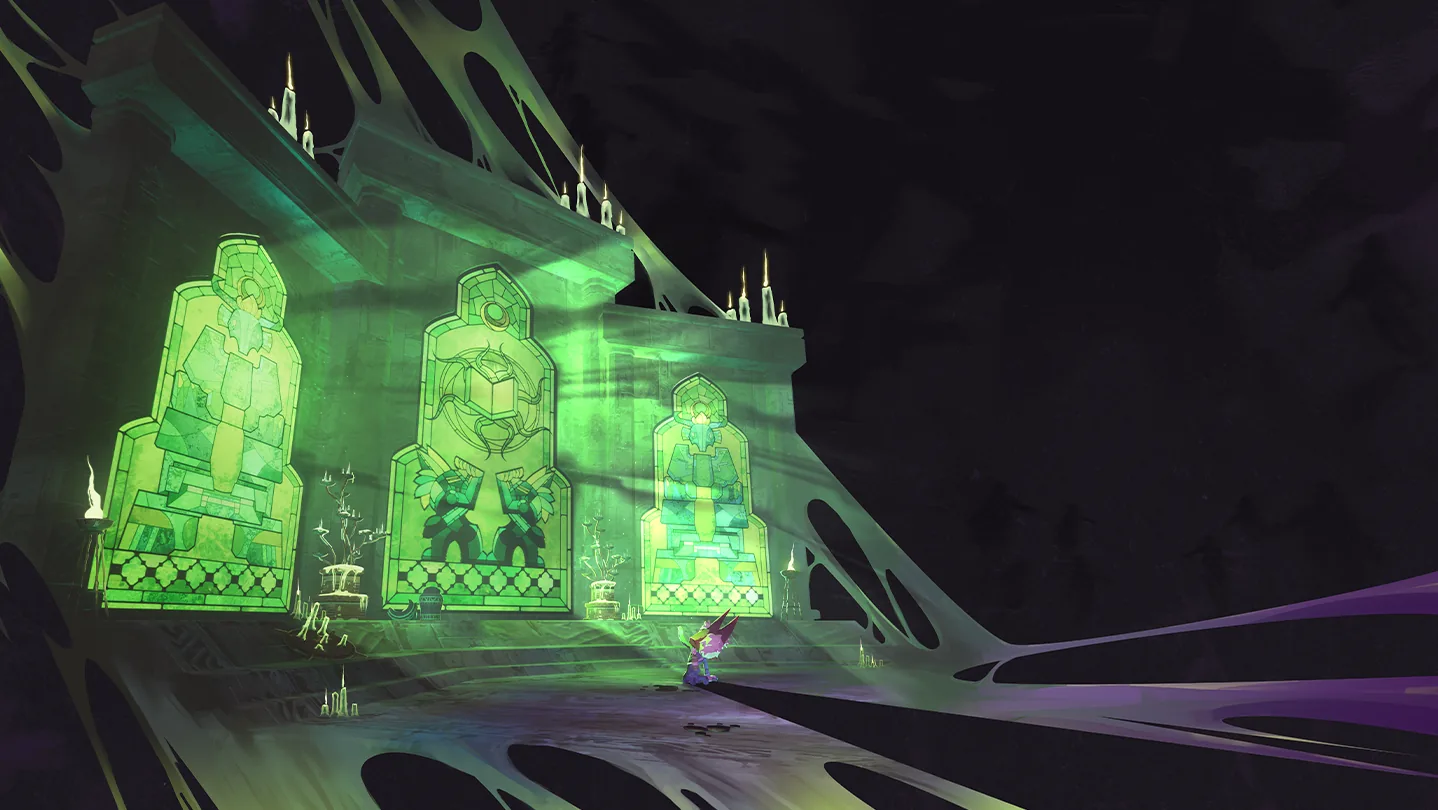
Hexes are Hallowed Concepts penalties that you pick up during a run and can exchange at a Hallowed Shrine. They have no beneficial effect on their own. To remove eligible permanent Hexes, use the shrine's Hand of Life, labeled Embrace Life. The opposite hand, Embrace Death, gives the team more Hexes and closes the cleansing option at that shrine.
Decide whether you want to cleanse before using either hand. The two choices are exclusive, and accepting more Hexes does not let you remove them immediately at the same shrine afterward. A Hex can be useful as a future exchange resource, but you must survive its actual drawback until you reach an appropriate cleansing opportunity.
Separate a penalty from the item it can buy
The expansion contains fourteen Hexes. Their role is different from that of ordinary beneficial items: you carry a drawback now and may later exchange eligible Hexes for an item reward. Do not evaluate a pickup only by the Hallowed Item you hope to receive at the end.
A Hex description can point toward a future Hallowed reward without guaranteeing that every small exchange produces a Hallowed Item. The shrine's selectable reward grades depend on how many Hexes it drains. Cleansing a small number can produce ordinary item choices rather than the expansion reward you imagined when collecting the penalty.
That creates two separate decisions. The first is whether your current run can tolerate taking the Hex. The second is whether to remove your eligible Hexes at the next shrine or carry them farther for a different reward opportunity. A build that is already struggling may benefit more from removing the penalty than from trying to maximize the later selection.
Check where new Hexes come from
A Concept Reliquary can provide Hexes. The Hand of Death at a Hallowed Shrine is another source: it drops three random Hexes per player in the run. The drops are shared, so an individual player can pick up Hexes that were generated as part of the team's total.
Hexes must be picked up manually. Merely activating the Hand of Death does not prove that every generated Hex has been added to your own inventory. In a group, check who actually collected the drops and what penalties each player now carries before proceeding.
The hand selects from the fourteen Hexes with equal odds. It is not a menu that lets you choose the most manageable penalty for your character. If your plan requires a particular Hex, do not assume that repeatedly planning around the Hand of Death guarantees that exact result at the next shrine.
Ground drops also have a time limit tied to progression. Starting a Teleporter charge destroys every Hex lying on the ground. If the group wants to collect them, settle that decision before someone starts the next charge. If you intend to leave a penalty unclaimed, do not count it as a resource you can necessarily return to afterward.
Understand Hex of Rain's shared difficulty pressure
Hex of Rain increases the rate at which difficulty rises with time by 25% per stack in a solo run. Monster level follows that time-based scaling and rises faster as well. This affects the run's future pressure rather than simply dealing a single immediate hit to your character.
In multiplayer, stacks held by all players are combined. The total bonus is divided by the number of players raised to the power of 0.75. The approximate increase per stack is 14.9% with two players, 11% with three, and 8.8% with four.
| Players in the run | Approximate extra time scaling per Hex of Rain stack |
|---|---|
| One | 25% |
| Two | 14.9% |
| Three | 11% |
| Four | 8.8% |
A teammate taking this Hex therefore matters to the whole group. Looking only at your own inventory can understate the total effect. Count the team's stacks when deciding whether the reward tradeoff is worth extending the run under faster scaling.
The smaller per-stack number in a larger lobby does not make the penalty disappear. There can also be more stacks across the team. Compare the combined inventory and the route you intend to play rather than declaring a multiplayer pickup safe because its individual contribution is lower.
Recognize the inventory disruption from Hex of Loss
Hex of Loss disables 10% of your inventory's items every thirty seconds, with an additional 10% per stack. That penalty can undermine the effects your build is currently relying on, even when the corresponding item icons are still recognizable in the inventory.

If an effect seems to have stopped working while you carry this Hex, first consider whether the item has been disabled. Do not immediately respond by changing your combat rotation as though the Survivor's skill has changed. The problem may be the availability of an item effect during the current penalty state.
This matters at the shrine as well. Hexes currently disabled by Hex of Loss are ignored by the Hand of Life's eligibility check. The total number of Hex-related icons you can see may therefore differ from the number the shrine can drain at that moment.
Avoid treating disabled inventory as already cleansed inventory. Disabled and removed are different states. A successful Hand of Life exchange actually drains eligible Hexes; an item being temporarily unavailable under a penalty does not by itself prove that the penalty has been converted into a reward.
Identify which Hexes can be cleansed
The Hand of Life requires at least one eligible permanent Hex. Temporary and rented Hexes do not count for its normal exchange. Hexes disabled by Hex of Loss are also ignored. If the hand cannot be used, check those distinctions before assuming that any visible Hex stack should satisfy it.
When you activate the hand, it drains eligible Hexes one at a time until it has taken seven or you have no more eligible Hexes. You cannot choose a smaller amount for that activation. Planning to exchange only one stack while keeping the others does not match the interaction's automatic drain.
The drain selects random Hexes with weighting based on stack count. Larger stacks are more likely to be chosen. If your goal is to remove one specific penalty, do not assume that the first Hex taken will be the one that is bothering you most. Count the remaining inventory after the exchange rather than predict the random removal order.
The hand can reopen after the exchange. Someone with more than seven eligible Hexes can use it again, and another eligible player can also use it. This lets you clear a larger inventory through multiple activations without mistaking the per-use cap for a permanent limit on the shrine's cleansing side.
Read the reward choices after the drain
The regular Hand of Life produces a Hallowed Potential with nine displayed options, arranged in three groups. Only one option can be taken from each group. The number of selectable options and available picks depends on how many Hexes were drained.
One Hex permits one Low-grade pick. Two through four Hexes permit two picks, with more Medium-grade options becoming selectable as the drain increases. Five through seven permit three picks and begin opening the higher-grade choices. Some displayed options remain locked, so seeing an appealing item in the Potential does not mean you can select it.
At the regular shrine, the first High-grade option becomes selectable after five Hexes are drained. High-grade options strongly favor Hallowed Items, while the Max-grade option introduced at seven favors Legendary or Boss items. The two High options and the Max option share the third group, so opening more of them gives alternatives for that group's pick rather than letting you collect all three.
This is why quantity matters without turning every extra Hex into another item. Compare the group choices and the actual number of picks, not just the number of images shown in the interface. Select a reward that supports the run you still need to finish after the exchange.
Account for a different cleansing opportunity
An improved Hallowed Shrine can appear in Soulbound Threshold after the Anima Harvester encounter and a further altar interaction. Its Hand of Life uses better reward grades than the ordinary stage shrine, while retaining the rule that each group provides at most one pick.
That opportunity does not make the route free of risk. Reaching it requires completing the relevant encounter. The decision to carry penalties there should include your ability to finish the route while those penalties remain active, rather than compare only the improved reward menu with a normal shrine's menu.
During the Anima Harvester fight's second phase, each player receives three Hexes that can be cleansed at that later shrine. Check the resulting inventory and the actual shrine interaction before deciding whether you need to accumulate additional penalties elsewhere.
With Artifact of Command enabled, the normal Potential presentation changes: the shrine drops an item for each pick rather than presenting the ordinary nine-option Potential. Do not assume that an artifact overrides all of the shrine's exchange and selection rules simply because it changes item selection elsewhere in a run.
Make the Hand of Death decision before committing
Embrace Death adds penalties; it does not cleanse the penalties you already have. Its three-Hex-per-player reward is a flat number, not a doubling of the current inventory. A player carrying one Hex and a player carrying several do not cause it to scale proportionally with their existing stacks.
Using Hand of Death closes Hand of Life and eventually the whole shrine. If you need relief from a dangerous penalty now, collecting more Hexes at this shrine moves you away from that immediate goal. Conversely, using Hand of Life closes Hand of Death, so you cannot cleanse and then generate another set of Hexes from the same shrine.
In a group, agree on the purpose of the interaction before someone activates it. One player may be trying to remove a troublesome penalty while another is pursuing a challenge or collecting exchange resources. The shared shrine choice can affect both plans even though their inventories are different.
Before leaving the stage, confirm the result you intended: the correct hand was used, the desired ground drops were either collected or deliberately left, the inventory reflects any successful cleanse, and the available reward picks have been taken. These checks distinguish a completed exchange from a shrine that was only activated while the most important parts of its result were overlooked.